

Proposition H FY 2025 Audit
Proposition H Revenue and Expenditure Performance Audit: The Public Safety Oil Production Act Generated Nearly $3 Million in Additional Revenue for Public Safety in Fiscal Year 2025
January 2026
Laura L. Doud
Report Summary
Why This Audit Is Important
In 2007, Proposition H (Prop H) Police and Fire Public Safety Oil Production Act passed with 70% in favor of the vote. Since its inception, Prop H has generated $61 million in total funding for first responders and public safety programs in the Police and Fire Departments at no additional cost to the taxpayers. Prop H funds help support critical City services that address public safety needs.
Audit Objective
The audit objective is to identify Prop H revenues and expenditures and assess whether expenditures comply with the approved uses outlined in the Long Beach Municipal Code.
Acknowledgement
We thank management and staff in the Police, Fire, and Financial Management Departments for their collaboration and assistance during this audit.
What We Found
We found Prop H revenue received during Fiscal Year (FY) 2025 was calculated properly. Our audit reviewed reports from oil companies submitted to the City of Long Beach (City) detailing the amount of oil produced during the fiscal year.
In FY 2025, Prop H continued to generate approximately $3 million in additional revenue for the Police and Fire Departments.
Additionally, FY 2025 expenditures of Prop H funds adhered to the approved uses set forth in the Long Beach Municipal Code.
In FY 2025, the Police Department spent Prop H funds on personnel costs for the Quality of Life (QOL) and Mental Health Evaluation Team (MET) programs which support homelessness outreach and mental health services, while the Fire Department spent Prop H funds on personnel costs for Fire Truck 17 which support emergency and medical responses. These expenditures complied with the approved uses as set forth in the Long Beach Municipal code.
The audit also examined proposed uses of FY 2026 Prop H funds and confirmed that their allocation to anticipated projects and programs aligned with the approved uses outlined in the Long Beach Municipal Code.
I. Background
Proposition H amended the City of Long Beach’s Municipal Code to assess an additional 25 cents per barrel on oil producers in Long Beach.
On May 1, 2007, the City of Long Beach (City) constituents approved Proposition H (Prop H), known as the Police and Fire Public Safety Oil Production Act, with 70% of the vote. Prop H amended the Long Beach Municipal Code to impose an additional tax of 25 cents per barrel on oil producers in Long Beach. The City adjusts this special oil tax annually on June 1st based on the Consumer Price Index (CPI). The Long Beach Municipal Code §3.80.227 requires an annual audit of Prop H revenues and expenditures during each fiscal year. This audit reviews Fiscal Year (FY) 2025, spanning from October 1, 2024, through September 30, 2025. Since the CPI rate adjustment takes effect on June 1st, the applicable tax rate reflects a blended rate for the year. The City implemented the special oil tax on June 1, 2007 and has adjusted it as follows:
Figure 1.
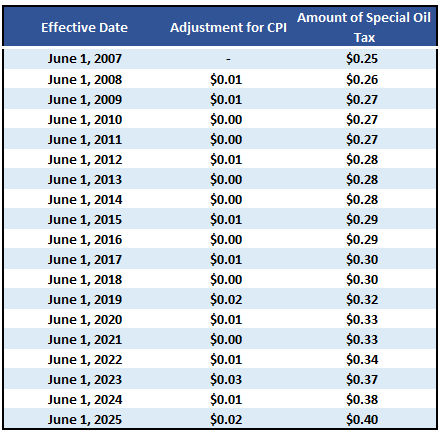 Proposition H tax rates increased from $0.25 in June 2007 to $0.40 in June 2025.
This special oil tax is in addition to the existing business tax of 30 cents per oil barrel produced, and it is adjusted annually for CPI. Oil producers must submit payments to the City on or before the last day of the calendar quarter. The special oil tax payment is calculated based on a production quarter that ends one month earlier than the calendar quarter.
For example, the Long Beach Municipal Code requires the special oil tax payment for the production quarter ending August 31, 2025, to be submitted to the City on or before September 30, 2025. If oil producers fail to meet this deadline, the City will impose a 25% penalty on the total tax amount. Oil producers would be required to pay this 25% penalty on the first day of the month following the close of the calendar quarter. For each subsequent month the tax remains unpaid, the City would assess an additional 10% penalty. The maximum penalty payment is 100% of the tax amount.
The City may use the special oil tax only to fund public safety, specifically covering costs related to police officers and firefighters and also includes equipment, facilities, and training necessary to respond to public safety needs.
THUMS Long Beach Company, Tidelands Oil Production Company, and Signal Hill Petroleum, Inc. were Long Beach’s top oil producers in Fiscal Year 2025.
In FY 2025, oil operators in Long Beach reported 7,177,583 total barrels of oil produced. THUMS Long Beach Company (THUMS), Tidelands Oil Production Company (TOPKO), and Signal Hill Petroleum, Inc. (SHPI) were the City’s top oil producers in FY 2025.
Figure 2.
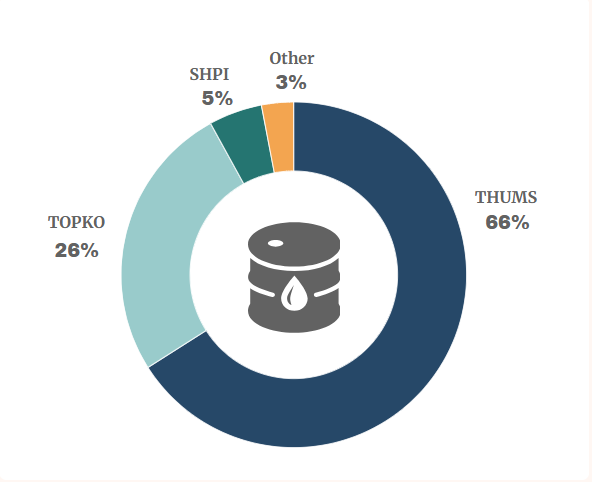 THUMS Long Beach Company (THUMS), Tidelands Oil Production Company (TOPKO), and Signal Hill Petroleum, Inc. (SHPI) accounted for 97% of the oil produced in Fiscal Year 2025.
Oil production in Long Beach is predominantly from the Wilmington Oil Field, which was discovered in 1932 and is divided into two sections: West and East. This field extends 13 miles long and 3 miles wide, from San Pedro to Seal Beach.
THUMS serves as the field contractor for the eastern portion and TOPKO serves as the field contractor for the western portion of the Wilmington Oil Field. In FY 2025, THUMS produced 4,702,876 oil barrels while TOPKO produced 1,901,955 oil barrels.
The third largest oil producer in Long Beach, SHPI, operates seven oil wells located in Long Beach and Signal Hill. The Bryant Lease, All Wells, H&L Lease, B-302, West Unit, Graner Oil Company, and TC-1 are all operated by SHPI. In FY 2025, SHPI produced 384,886 oil barrels in Long Beach.
Since Prop H’s inception through September 30, 2025, annual oil production in Long Beach has fluctuated. Oil production has declined by 46% since FY 2015. In FY 2025, production decreased by 9% from the prior year, as shown in Figure 3 below.
Figure 3.
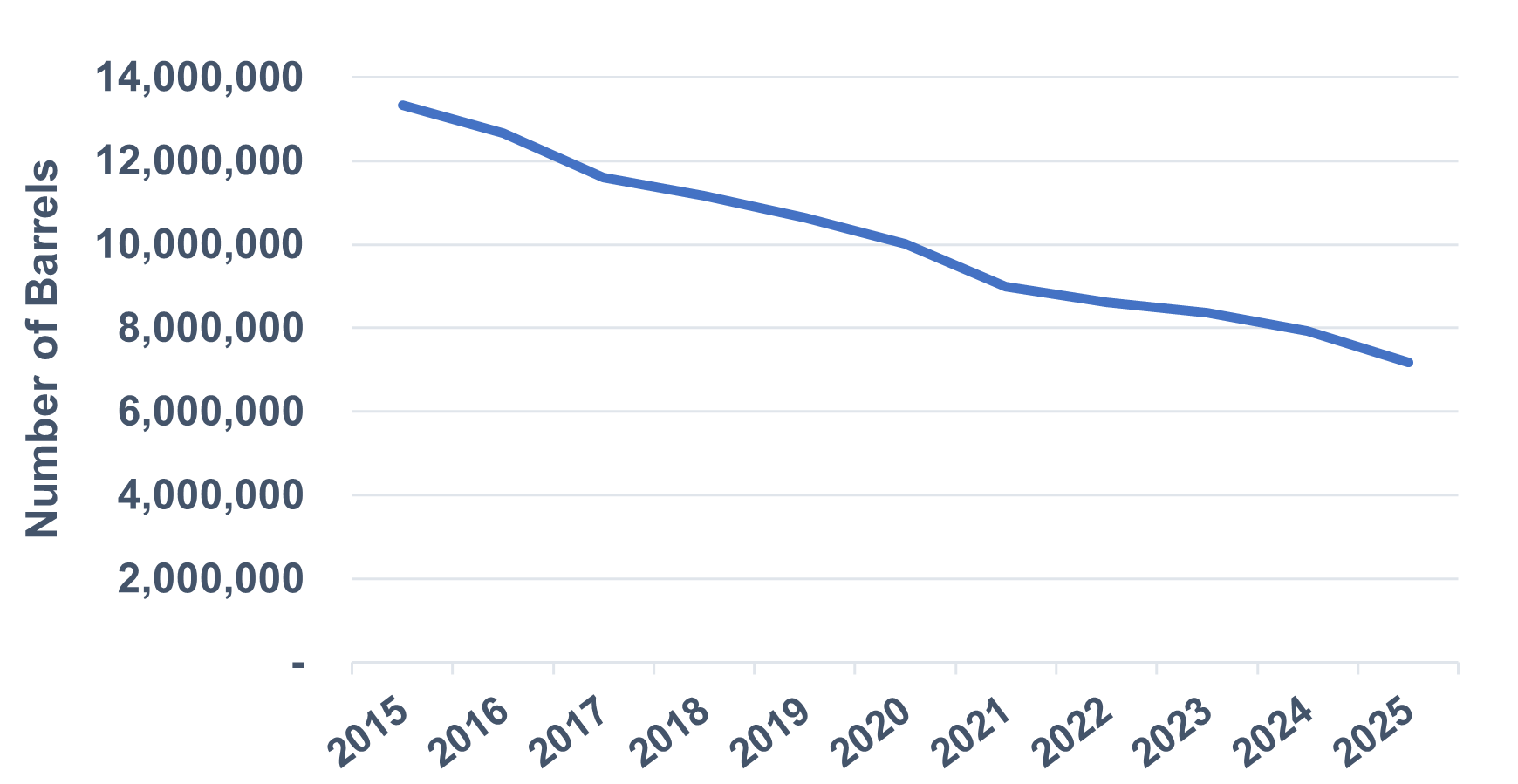 Annual oil production has decreased by 46% since Fiscal Year 2015.
Based on the oil production levels shown above, Prop H revenue received by the City shows similar fluctuations in revenue with a decrease over time. Prop H revenue has decreased 25% between FY 2015 and FY 2025, as shown in Figure 4 below.
In FY 2025, Prop H revenue decreased by 5% from the previous fiscal year. The CPI adjustments added 0.02 cents per barrel, changing the tax rate from 38 cents in FY 2024 to 40 cents per barrel in FY 2025. Even though the CPI adjustments increased the cents per barrel, the decline in oil production continues to affect the overall oil tax revenue received by the City.
Figure 4.
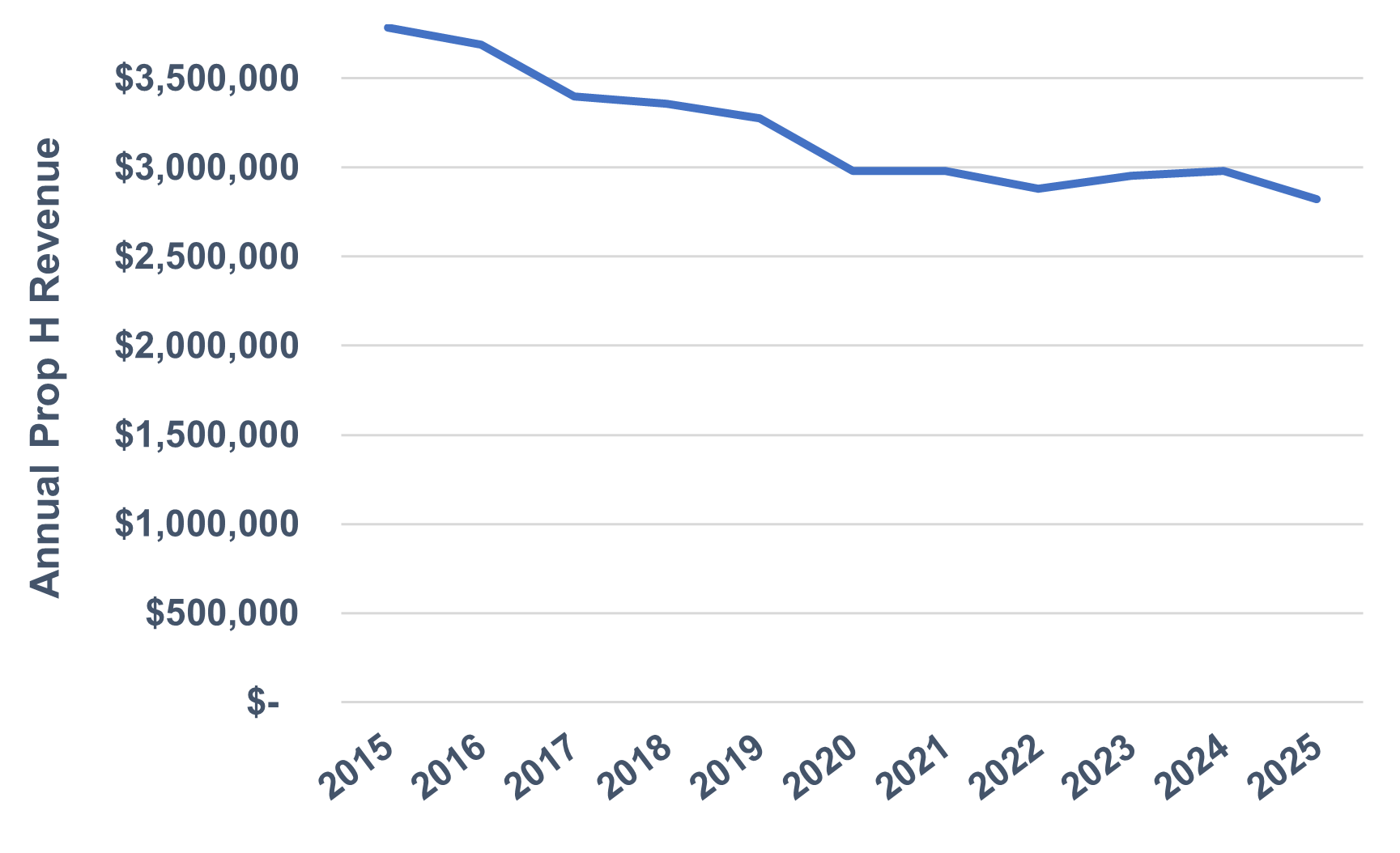 Proposition H revenue has decreased 25% from Fiscal Year 2015 to 2025.
In FY 2025, oil prices began with a monthly average of $71.99 per barrel. The daily West Texas Intermediate Crude Index’s monthly average did not go below $20 for any month within the fiscal year. By June 2025, prices decreased to $68.17 and after a slight increase to $68.39 in July, monthly oil prices continued a downward trend. The fiscal year closed with a monthly average of $63.96 per barrel, as shown in Figure 5 below.
Figure 5.
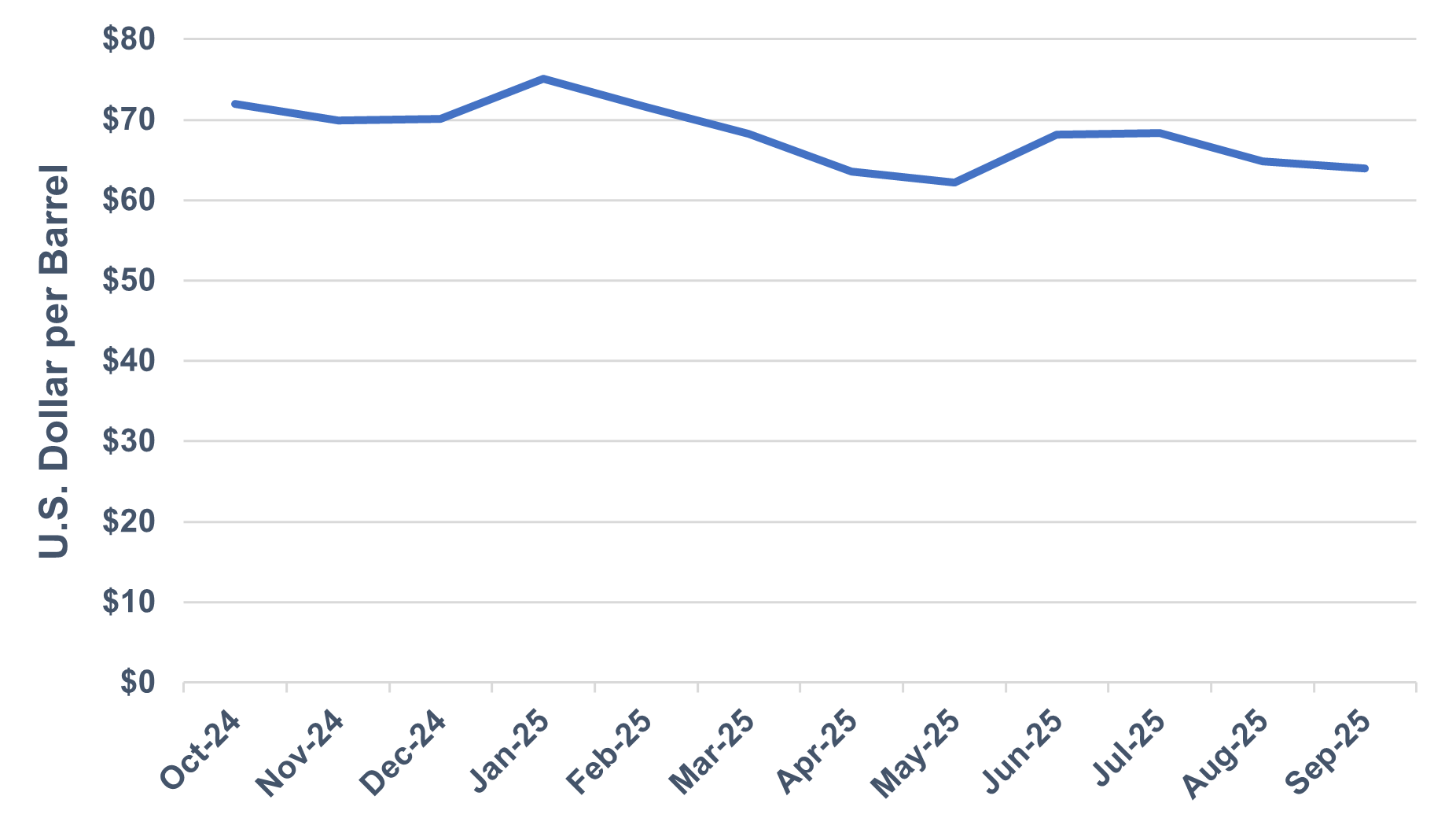 The West Texas Intermediate Crude Index monthly oil price per barrel declined at the end of Fiscal Year 2025.
II. Audit Results
Objective #1: Identify Proposition H revenues received during Fiscal Year 2025 and determine if funds remitted by the oil producers were properly calculated based on oil producers’ reports remitted to the City.
The City collected a total of $2,821,057 in Prop H oil tax revenue, including penalties and interest during FY 2025. This is a decrease of $158,624, or 5%, from the previous fiscal year. The oil tax revenue received was based on FY 2025 production reports totaling 7,177,583 barrels of oil in FY 2025.
Figure 6.
 The City of Long Beach received nearly $3 million in Proposition H oil tax revenue in Fiscal Year 2025.
We tested 97% of the special oil tax revenues received in FY 2025 through confirmations with the top oil producers. We determined that oil producers had calculated the remitted funds correctly based on the oil production reports they provided to the City.
In FY 2025, the City correctly deposited the special oil tax revenues and penalties into Fund 2100, the Fire Public Safety Oil Production Tax Special Revenue Fund, and Fund 2150, the Police Public Safety Oil Production Tax Special Revenue Fund, as required by §3.80.225 of the Long Beach Municipal Code. The City appropriately divided the revenues between the two funds.
Conclusion 1: Proposition H revenues received during Fiscal Year 2025 were calculated properly based on amounts confirmed by oil producers.
Objective #2: Identify Fiscal Year 2025 expenditures of Proposition H funds and analyze whether such expenditures complied with the approved uses set forth in the Long Beach Municipal Code.
During FY 2025, Prop H expenditures totaled $2,797,154 and the City used the funds for projects and programs as defined in the Long Beach Municipal Code.
In FY 2025, the Police Department spent $1,402,341 in Prop H funds. Of this amount, $1,394,813 (99%) covered personnel costs for Critical Services, which includes the Quality of Life (QOL) and Mental Health Evaluation Team (MET) programs, funding salaries and benefits for 14 police officers and a sergeant assigned to these programs. The QOL program performs outreach and responds to individuals experiencing homelessness. QOL officers connect the unsheltered community to supportive services, such as community support groups, shelters, transportation, mental health services, and housing resources. The MET program responds to service calls for individuals needing access to mental health services or experiencing a crisis. The MET program consists of sworn officers partnered with clinicians from the Los Angeles County Department of Mental Health.
The Police Department used the remaining $7,528 (1%) of Prop H funds on interfund service expenditures.
In FY 2025, the Fire Department spent $1,394,813 in Prop H funds. Of this amount, $1,387,285 (99%) covered personnel costs for Fire Truck 17, funding salaries and benefits for the staff assigned to it, including a fire captain, a fire engineer, and two firefighters. The Fire Department spent the remaining $7,528 (1%) of Prop H funds on interfund service expenditures.
Conclusion 2: Fiscal Year 2025 expenditures of Proposition H funds complied with the approved uses set forth in the Long Beach Municipal Code.
Objective #3: Determine the amount of unspent Proposition H funds on deposit as of September 30, 2025 that were carried over into Fiscal Year 2026 and in compliance with Financial Management’s Reserve Policy.
Financial Management has a Prop H Reserve Policy that establishes a range of $150,000 to $400,000 to cover potential declines in Prop H oil production revenues or any one-time needs. This policy ensures that the funds are spent timely and prevents the accumulation of excessive reserves.
During FY 2025, the carryover amount increased by 11% from the prior fiscal year, from $222,785 to $247,713. This amount is within the allowed carryover range established by Financial Management’s policy. The projected carryover for FY 2026 is expected to be $247,713 as shown in Figure 7 below.
Figure 7.
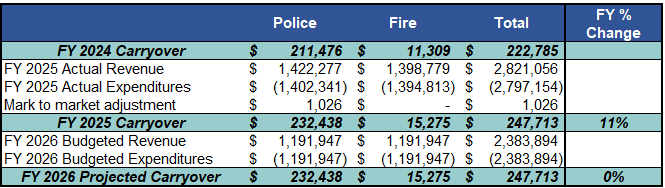 Total projected Fiscal Year 2026 carry-over amounts increased by 11% from the previous fiscal year.
Conclusion 3: The amount of unspent Proposition H funds at the end of Fisal Year 2025 that were carried into the current fiscal year is $247,713. This amount is in compliance with Financial Management’s Reserve Policy.
Objective #4: Determine the status of any projects and programs funded by Proposition H revenue and whether they comply with the approved uses set forth in the Long Beach Municipal Code.
In FY 2026, the Police Department plans to use all the budgeted Prop H revenue of $1,191,947 to help fund its QOL and MET programs. The funding will cover a portion of the personnel costs for eight QOL officers, six MET officers, and one sergeant.
In FY 2026, the Fire Department intends to use all budgeted Prop H funds of $1,191,947 to cover personnel costs for Fire Truck 17 and emergency medical equipment used by Firefighter Paramedics and Emergency Medical Technicians. This equipment includes gurneys, cardiac monitors, chest compression items, and consumable emergency medical equipment.
The Departments’ proposed uses for Prop H funds comply with the general provisions outlined in the Long Beach Municipal Code.
Conclusion 4: The anticipated projects and programs funded by Proposition H revenue in Fiscal Year 2026 comply with the approved uses set forth in the Long Beach Municipal Code
III. Objective, Scope, and Methodology
The Long Beach Municipal Code §3.80.227 requires an annual independent financial audit of Prop H revenues and expenditures during each fiscal year. The scope of our audit covers the period of October 1, 2024, through September 30, 2025.
The four primary objectives of this audit are as follows:
Identify Prop H revenues received during FY 2025 and determine if funds remitted by the oil producers were properly calculated based on oil producers’ reports remitted to the City;- Identify FY 2025 expenditures of Prop H funds and analyze whether such expenditures complied with the approved uses set forth in the Long Beach Municipal Code;
- Determine the amount of unspent Prop H funds on deposit at September 30, 2025 that were carried over into the current fiscal year, FY 2026; and
- Determine the status of any projects and programs funded by Prop H revenue and whether they comply with the approved uses set forth in the Long Beach Municipal Code.
To achieve these objectives, we performed the following procedures:
Obtained an understanding of internal controls surrounding the collection and recording of Prop H funds and calculated the annual change in the special oil tax rate based on the change in the annual average CPI.
Obtained the Oil Production Taxes Schedule from the Financial Management Department and recalculated Prop H revenues, evaluated penalties assessed, and traced payments from checks to the City’s financial system. Confirmed approximately 97% of the reported oil production amounts with the oil producers for FY 2025.
Identified the Prop H expenditures during FY 2025 and determined whether the expenditures were spent in accordance with the Long Beach Municipal Code and identified the amount of unspent Prop H funds on deposit at September 30, 2025 that were carried over into the current fiscal year, FY 2026.
Identified the Police and Fire Departments’ plans to use Prop H funds in the future and determined whether those plans are in accordance with §3.80.224 of the Long Beach Municipal Code.
We conducted this performance audit in accordance with Generally Accepted Government Auditing Standards (GAGAS). Those standards require that we plan and perform the audit to obtain sufficient, appropriate evidence to provide a reasonable basis for our findings and conclusions based on the audit objectives. We believe that the evidence obtained provides a reasonable basis for our findings and conclusions based on the audit objectives.
IV. Management Response
The Police, Fire and Financial Management Departments agreed with the information contained in the report and had no further comments.